I came back from Delft a little rough around the edges and of course feeling a little under the weather I felt it best to make us all sweat, so...
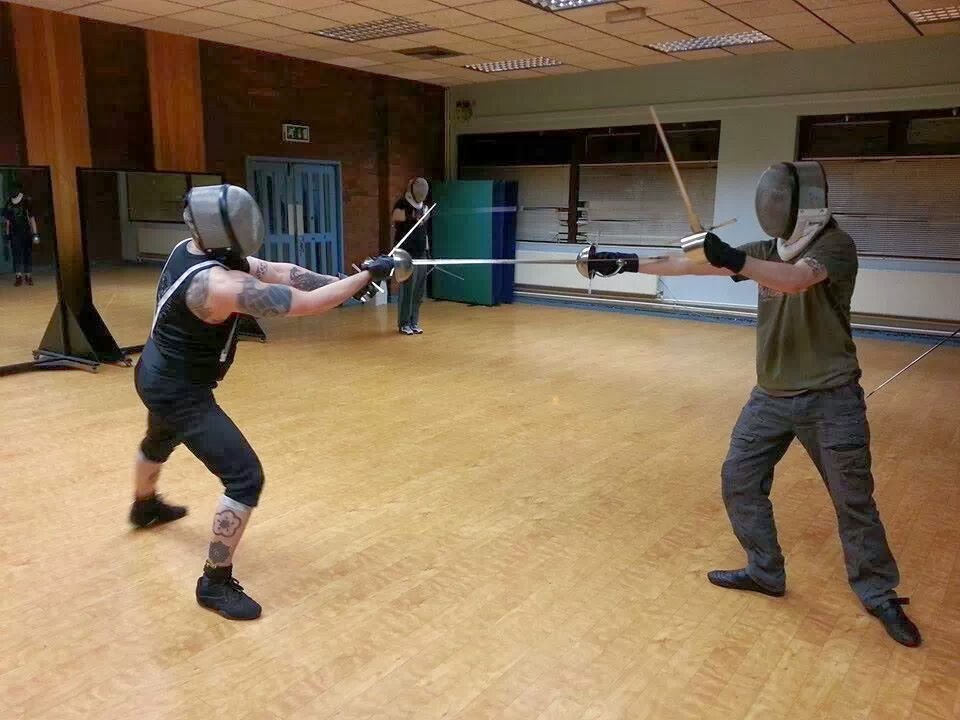
Monday's class consisted of little gems I borrowed from the other instructors in Delft.
A matched pacing warm up from Ton Puey, the beats and entries from Marcelli as shown by Francesco Lodà (very similar to Olympic fencing, a great way to warm the muscles learn timing and practice the footwork from di Grassi). Both were fantastic ways to warm up and blast through some core skills in a very short time.
Then it was time for a little bit of di Grassi, again working on the hurt from the high guard we looked at not only the footwork and thrust itself but also the psychology of the entry, dividing the opponent's mind between wishing to attack the obvious line and defending, while this schism is occurring entering in such a way that scoops up and crushes the counter before it (no doubt at this point there is some lamentation, then some milk based alcohol and a discussion about what is good in life).
We then looked at the counter to this from the low ward, applying a similar mind set. It is remarkable how much this style gives an almost Musashi five rings feel to your fencing, either overwhelming your opponent or flowing deceptively around them, one action and mind set made possible by the threat of the other.
We will have a few more weeks of di Grassi before going over some Cavendish and Thibault, but we will return to this often, it is simple, brutal and so much fun.

Tuesday, 8 April 2014

Sunday, 6 April 2014
Dastardly doings in Delft.
Well it's been pretty damn busy at the school. Of course we have the new class starting at Jackson's Lane of the 25th of April, but that hasn't stopped me from rushing off to Holland to teach at the International Rapier Seminar, it was an honour to teach alongside such notables as Thibault Ghesquière, Francesco Lodà, Ton Puey and of course our gracious host and co-instructor Reinier van Noort. I taught Cavendish which is proving to be a pleasant experience with most people seeming to move through slight disbelief, gradual comprehension then utter joy at slapping swords out of people's hands with gay abandon.
It is an unusual system but very effective and also very well informed, Cavendish it seems was a clever fellow. I will post a little more about it soon, but in the mean time thanks to everyone in this picture, it was an absolute pleasure to be there.

Class news.
Barbican Mondays: Rapier for a few more lessons - we will work on di Grassi, then back to more Thibault and Cavendish.
Beckenham Tuesdays: Staff & spear from Mair.
Wednesday Blackfriars/Waterloo: sword and buckler/shield, again di Grassi then back to I.33.
Thursday Clapham: Burn night, the most intense way to drill. Several weapon sets, hi rep and very fun.
Friday: Class opening in Highgate on 25th April, contact me for details.
It is an unusual system but very effective and also very well informed, Cavendish it seems was a clever fellow. I will post a little more about it soon, but in the mean time thanks to everyone in this picture, it was an absolute pleasure to be there.
Class news.
Barbican Mondays: Rapier for a few more lessons - we will work on di Grassi, then back to more Thibault and Cavendish.
Beckenham Tuesdays: Staff & spear from Mair.
Wednesday Blackfriars/Waterloo: sword and buckler/shield, again di Grassi then back to I.33.
Thursday Clapham: Burn night, the most intense way to drill. Several weapon sets, hi rep and very fun.
Friday: Class opening in Highgate on 25th April, contact me for details.
Friday, 14 March 2014
New class in Highgate and...
We are pleased to announce the opening of a new class at the fantastic Jackson's Lane starting on April 25th.
The hall is located right opposite Highgate tube station and will run from 7-8.30 pm every Friday.
For information on joining a class, call 0770 9639881 or email us at londonlongsword@gmail.com Please include a contact number.

Burn night is back! The Clapham class (now on Thursdays) has become the place to really push yourself. Each week we choose 3 weapon sets, spend 30 minutes running through the drills we will practice, then straight into an hour of non stop drilling, first solo then partnered.

The hall is located right opposite Highgate tube station and will run from 7-8.30 pm every Friday.
For information on joining a class, call 0770 9639881 or email us at londonlongsword@gmail.com Please include a contact number.
And
Burn night is back! The Clapham class (now on Thursdays) has become the place to really push yourself. Each week we choose 3 weapon sets, spend 30 minutes running through the drills we will practice, then straight into an hour of non stop drilling, first solo then partnered.
No talking, just training.
Wednesday, 26 February 2014
What's going on in March.
Another Charity Bash
Two great events happening this Saturday March the 1st. Firstly the charity bash (you can see a fight from the previous event above).
The dussack competition of course, this will run for 2 hours so we will be running a pool system, and...
"Let it be known on this day that Tim Fuke, student of weapons with the London Longsword Academy, has been given right to make challenge for his prize.
Know that he will:
Make challenge to five
of his peers, offering them choice of weapon.
That he shall fight for
an hour against their repeated assaults; allowing them rest but receiving none.
That he shall do this
for his honour and that of the school.
This being done with good
honour & skill & having fulfilled all other obligations of rank; he
will be honoured with the rank of scholar within the academy."
Tim has asked me to select his challengers for him, they have been notified and accepted.
Good luck Tim.
Classes.
Tuesday (Beckenham): Staff & Dussack.
Wednesday Blackfriars/Waterloo: Sword & buckler.
Thursday (Clapham): Longsword & shortstaff.
Friday: New classes starting soon. News to follow.
More help for the mittle.
is shown several times in Paulus Hector Mair's polearms and longsword work. Here I try and show casually how easy it is to flow into and out of. If you would like more updates and hints such as these don't forget to follow our YouTube channel (LondonLongsword) and to like our Facebook page.
Sunday, 12 January 2014
Lignitzer, a bucklerist by any other name.
For a very long time I have steered clear of Lignitzer's sword & buckler.
Not that I in any way felt it was a flawed system, rather I felt that there are big problems with the interpretations myself and others held.
My main issues were:
A lack of safety from the technique.
The technique requiring our partner to perform an action against reason.
The technique requiring our partner to perform an action against natural structure.
A decided lack of knowing how to hit the left leg.
Having had a lot more experience I decided to have a look back over the techniques, & I feel that I have come to a more structured set of techniques that work directly with the text, flow from play one to two, play two to three and so on.
There are points of commonality in how I am approaching these plays to Salvatore Fabris's sword & dagger, William Cavendish's sword against the off hand, the assorted plays from the works of Joachim Meyer, & my own experience in sparring, which suggest a similarity in method in working toward the opponent's offside*.
I feel that if there is a similarity across authors there are two main conclusions we can make. 1. That they are working from a similar tradition or 2. That structure limited by the human form makes for similar answers to said limitations. I work from the second assumption here, though I do not dismiss the possibility of the first.
So, to play one. Of which I have posted 2 examples. One showed with distance and caution as I am not wearing a mask. And second at ¾ speed to show the simplicity of the form performed at speed.
Here I will list the flaws of each run through before you see them so that you can be aware of them. Clip one: 1. The over hew being slow and placed rather than slammed in, does not force my partner's hands strongly to the left, which leads to 2. 2. A softening in the bind by my partner in anticipation of the thrust from below, which he knows is coming...which leads to 3. 3. a small testing of the bind from myself, in order to secure the line and force his hands to his left. This is exhibited by a small left wind by myself before the the thrust from below. As you see in clip two, this is not needed if you hew in with force.
Clip two: On occasion I separate my hands, also I relax at the end of each flurry, in order to shale out for the next. One is my poor execution, the other I allow myself as, I am not necessitated to leave
under a ward.
The piece: (taken from Keith Farrell's translation, hosted at wiktenauer). Here start the plays with the buckler as written by the master Andre Lignitzer. 1:The first play with the buckler from the Oberhaw. Mark when you drive the Oberhaw (over strike / strike from above) to the man:(2) with the pommel go inwards, your sword close to the buckler and your thumb, (3)and thrust in from beneath to his face. (4)Wind against his sword and then go with a snap over and around. (The numbers are my addition).
Reasoning behind this interpretation.
I will break these parts down for ease.
1:The first play with the buckler from the Oberhaw. Mark when you drive the Oberhaw (over strike / strike from above) to the man:
The first strike is clearly a strike at the man, not short of him. This in my opinion has created a flaw in interpretations caused by the section 3. A strike from above at the man, should bring a natural cover to high left (this being where the blow is aimed). I say natural for the opponent has two shields, the sword & the buckler, with which to cover himself, which common instinct will usually make him do, with shield or sword singularly or combined, passively or aggressively. Rarely will his instinct be to cut in a manner that drives his hands lower than yours (contrary to this in fact, usually if wishing to attack above the sword and buckler he will raise the hands as if performing a crown cut, covering the line and and the weak of the sword with no need to parry). The common interpretation requires our opponent to cut against instinct and common sense in a manner that either (by retreating/reclining) makes him drop both of his covers, or (cutting with his hands even lower) place his weak upon your strong. If he does not carry out these foolish actions I am greatly endangered by his point. Here in the clip my intention is to drive his cover by necessity up back and to his left. By making the strike at the man. At an angle behind his shield and, in turn to deal with his common reactions to this.
(2) with the pommel go inwards, your sword close to the buckler and your thumb, By striking in such a manner that my point is to the inside of the sword (His inside, my outside) to his left ear, and driving the cut so that my pommel is moving further to my inside (hence his outside), I am set up in such a way that sliding the tip of my sword up toward the tip of his, disengaging to thrust up from below, is natural, pre aligned and indeed leaves me covered against the return of his sword. In effect, I am suggesting that the pommel going in dictates the placement of the following thrust.
(3)and thrust in from beneath to his face. Wind against his sword...
I am turning the thrust into a wind immediately (as happens later in the plays) in order to cover his sword. The thrust from below is commonly flawed as, attempting it from the flawed position I mention in (1), the party delivering it is either endangered by his partner's point, or necessitated to wind to his left winding before he can thrust safely. The thrust as I am delivering it is driven naturally as in the under hew toward the right elbow mentioned in many treatises (I assume) influenced by Liechtenauer, which also flow out of an over hew at the left ear. The thrust as I show it however, covers the weak of our partner's sword more immediately than the aforementioned cut, offering us better and quicker cover.
(4)then go with a snap over and around.
If we have performed the thrust from below as I have mentioned through an open line, that through its dominance of that line through our wind keeps our partner out of it, to force them to be outside the line or press it aside and down with force regain to it we create the perfect circumstance for a snap over. Often in the common interpretation of this piece the action of the snap is unnatural, coming from a position with a the right hand low and out (to stay true to the text's thrust from below) which forces an unnatural cranking in the wrist to allow the striking of a blow from left to right. Or again leaves our opponent's point free which is then still a danger to us. In each of these parts of the piece I have tried to show how you may, move against your opponent’s natural responses, without fencing short, or requiring your partner to abandon reason, all I hope within the structure of the text. Now it may be that you disagree with me, this is fine. I hope that you will look at my points with an open mind, see how they benifit your sword play and if you find some small part helpful I am glad.
*I will not go into detail about these here, but I would suggest you read through all of these works if possible, & if you are unable to...well there is an instructional DVD on the way which will give examples of the other sources mentioned.
Not that I in any way felt it was a flawed system, rather I felt that there are big problems with the interpretations myself and others held.
My main issues were:
A lack of safety from the technique.
The technique requiring our partner to perform an action against reason.
The technique requiring our partner to perform an action against natural structure.
A decided lack of knowing how to hit the left leg.
Having had a lot more experience I decided to have a look back over the techniques, & I feel that I have come to a more structured set of techniques that work directly with the text, flow from play one to two, play two to three and so on.
There are points of commonality in how I am approaching these plays to Salvatore Fabris's sword & dagger, William Cavendish's sword against the off hand, the assorted plays from the works of Joachim Meyer, & my own experience in sparring, which suggest a similarity in method in working toward the opponent's offside*.
I feel that if there is a similarity across authors there are two main conclusions we can make. 1. That they are working from a similar tradition or 2. That structure limited by the human form makes for similar answers to said limitations. I work from the second assumption here, though I do not dismiss the possibility of the first.
So, to play one. Of which I have posted 2 examples. One showed with distance and caution as I am not wearing a mask. And second at ¾ speed to show the simplicity of the form performed at speed.
Here I will list the flaws of each run through before you see them so that you can be aware of them. Clip one: 1. The over hew being slow and placed rather than slammed in, does not force my partner's hands strongly to the left, which leads to 2. 2. A softening in the bind by my partner in anticipation of the thrust from below, which he knows is coming...which leads to 3. 3. a small testing of the bind from myself, in order to secure the line and force his hands to his left. This is exhibited by a small left wind by myself before the the thrust from below. As you see in clip two, this is not needed if you hew in with force.
Clip two: On occasion I separate my hands, also I relax at the end of each flurry, in order to shale out for the next. One is my poor execution, the other I allow myself as, I am not necessitated to leave
under a ward.
The piece: (taken from Keith Farrell's translation, hosted at wiktenauer). Here start the plays with the buckler as written by the master Andre Lignitzer. 1:The first play with the buckler from the Oberhaw. Mark when you drive the Oberhaw (over strike / strike from above) to the man:(2) with the pommel go inwards, your sword close to the buckler and your thumb, (3)and thrust in from beneath to his face. (4)Wind against his sword and then go with a snap over and around. (The numbers are my addition).
Reasoning behind this interpretation.
I will break these parts down for ease.
1:The first play with the buckler from the Oberhaw. Mark when you drive the Oberhaw (over strike / strike from above) to the man:
The first strike is clearly a strike at the man, not short of him. This in my opinion has created a flaw in interpretations caused by the section 3. A strike from above at the man, should bring a natural cover to high left (this being where the blow is aimed). I say natural for the opponent has two shields, the sword & the buckler, with which to cover himself, which common instinct will usually make him do, with shield or sword singularly or combined, passively or aggressively. Rarely will his instinct be to cut in a manner that drives his hands lower than yours (contrary to this in fact, usually if wishing to attack above the sword and buckler he will raise the hands as if performing a crown cut, covering the line and and the weak of the sword with no need to parry). The common interpretation requires our opponent to cut against instinct and common sense in a manner that either (by retreating/reclining) makes him drop both of his covers, or (cutting with his hands even lower) place his weak upon your strong. If he does not carry out these foolish actions I am greatly endangered by his point. Here in the clip my intention is to drive his cover by necessity up back and to his left. By making the strike at the man. At an angle behind his shield and, in turn to deal with his common reactions to this.
(2) with the pommel go inwards, your sword close to the buckler and your thumb, By striking in such a manner that my point is to the inside of the sword (His inside, my outside) to his left ear, and driving the cut so that my pommel is moving further to my inside (hence his outside), I am set up in such a way that sliding the tip of my sword up toward the tip of his, disengaging to thrust up from below, is natural, pre aligned and indeed leaves me covered against the return of his sword. In effect, I am suggesting that the pommel going in dictates the placement of the following thrust.
(3)and thrust in from beneath to his face. Wind against his sword...
I am turning the thrust into a wind immediately (as happens later in the plays) in order to cover his sword. The thrust from below is commonly flawed as, attempting it from the flawed position I mention in (1), the party delivering it is either endangered by his partner's point, or necessitated to wind to his left winding before he can thrust safely. The thrust as I am delivering it is driven naturally as in the under hew toward the right elbow mentioned in many treatises (I assume) influenced by Liechtenauer, which also flow out of an over hew at the left ear. The thrust as I show it however, covers the weak of our partner's sword more immediately than the aforementioned cut, offering us better and quicker cover.
(4)then go with a snap over and around.
If we have performed the thrust from below as I have mentioned through an open line, that through its dominance of that line through our wind keeps our partner out of it, to force them to be outside the line or press it aside and down with force regain to it we create the perfect circumstance for a snap over. Often in the common interpretation of this piece the action of the snap is unnatural, coming from a position with a the right hand low and out (to stay true to the text's thrust from below) which forces an unnatural cranking in the wrist to allow the striking of a blow from left to right. Or again leaves our opponent's point free which is then still a danger to us. In each of these parts of the piece I have tried to show how you may, move against your opponent’s natural responses, without fencing short, or requiring your partner to abandon reason, all I hope within the structure of the text. Now it may be that you disagree with me, this is fine. I hope that you will look at my points with an open mind, see how they benifit your sword play and if you find some small part helpful I am glad.
*I will not go into detail about these here, but I would suggest you read through all of these works if possible, & if you are unable to...well there is an instructional DVD on the way which will give examples of the other sources mentioned.
Tuesday, 31 December 2013
Happy new year!
It's been a brilliant year for the school. Thanks so much to everyone who has made it such a good one.
We have a special first class at the Clapham hall this Friday. No matter which LLA class you belong to, you are welcome to attend. We will make room.
And to everyone, student or stranger. Have the most excellent new year.
Friday, 27 December 2013
The Days of Wrathmas 3-4
Following on from the previous post, two more clips from the Sword London*. "Days of Wrathmas" series of solo drills.
Wrath 3
I hope you enjoy them, feel free to visit the facebook page if you have questions about the drills or classes.
Wrath 4
* Our facebook page, don't forget to follow us;).
Wrath 3
I hope you enjoy them, feel free to visit the facebook page if you have questions about the drills or classes.
Wrath 4
* Our facebook page, don't forget to follow us;).
Subscribe to:
Posts (Atom)